
Every smart home system — lighting, audio, security, Control4 — depends on a professional network infrastructure beneath it. We design and build that foundation before a single smart device goes in.
Request Consultation Learn MoreEvery device — controller, touchscreen, camera, access point — wired back to a central rack with CAT6A for maximum speed and reliability.
Professional-grade Ubiquiti switches, routers, and access points — the same gear used in enterprise environments, installed in your home.
Managed switches prioritize Control4 traffic so a 4K stream never interferes with a lighting command or a security alert.
From the main cottage to the boathouse, dock, and guest house — we extend the network to every corner of your property.
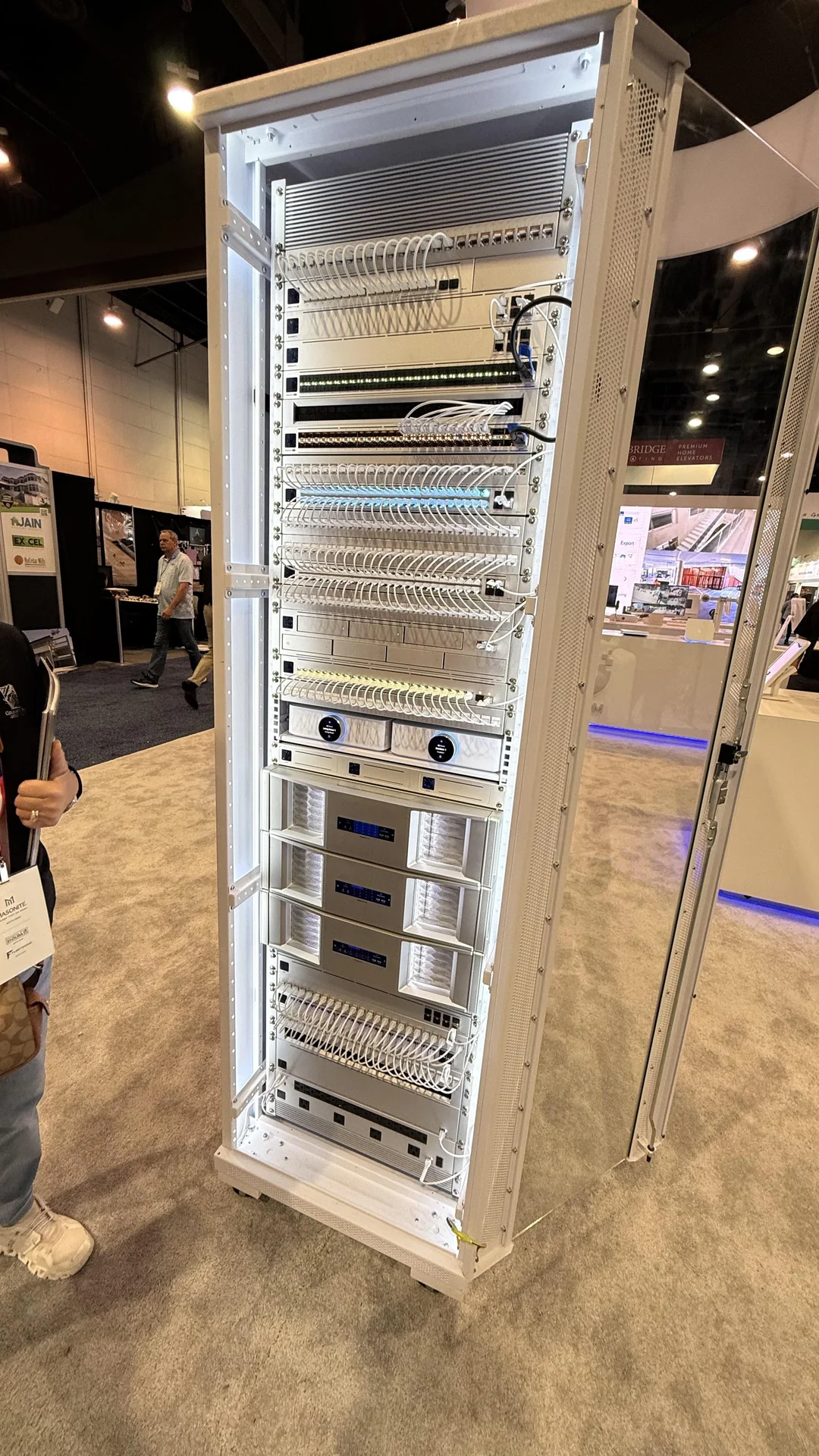
The most sophisticated Control4 system will underperform on a consumer-grade router. Dropped commands, buffering audio, laggy touchscreens — these are network problems, not smart home problems. We eliminate them at the foundation.
A properly designed structured wiring infrastructure means every device has a dedicated, reliable connection. The network never becomes the bottleneck — and your automation system performs exactly as it should, every time.
Talk to us about your project →Backbone switching capacity
Standard wiring specification
Power over Ethernet for cameras & APs
Dead zones tolerated
A professional smart home network isn't a single device — it's a layered system designed for reliability, performance, and future expandability.
All structured wiring terminates in a central equipment rack — routers, switches, Control4 controllers, amplifiers, and patch panels in one organized, accessible location.
Managed switches allow us to configure VLANs, QoS traffic prioritization, and port-level monitoring — ensuring Control4 commands always take precedence over general network traffic.
Ceiling-mounted Ubiquiti access points — wired with CAT6A and placed during rough-in — deliver seamless, high-speed Wi-Fi across every room and outdoor space.
CAT6 runs to every camera location carry both data and power over a single cable — no separate power supply required, and every camera feeds back to the central NVR.
For boathouses, guest houses, and outbuildings, we run fibre optic cable rather than copper — immune to lightning-induced surges and capable of gigabit speeds over any distance.
Control4 panelized lighting requires 4-conductor bus cable daisy-chained between keypads. We specify and document this at the design stage so your electrician installs it correctly the first time.
Getting the wiring right during construction is the single most cost-effective investment in your smart home. Here's what we specify at rough-in stage.
CAT6A to ceiling locations throughout the home and outdoors — sized and positioned based on a professional RF site plan, not guesswork.
CAT6 to every interior and exterior camera position. PoE eliminates local power runs — one cable per camera, all terminating at the central rack.
2–3 CAT6 runs plus coaxial to every TV location — for internet, IP video distribution, and audio return channel. Future-proof from day one.
4-core speaker wire from every in-ceiling and in-wall speaker location back to the central rack — sized for the amplifier configuration.
CAT6 to every touchscreen and controller location. Wired Ethernet — not Wi-Fi — for Control4's primary control surfaces ensures rock-solid reliability.
Fibre optic conduit to boathouses, garages, and guest houses — installed during site work before the ground is closed, at a fraction of the retrofit cost.